The benefits of AI in software development nobody talks about

Everyone knows AI makes software faster to build for experienced engineers. After 25 years of building software, I can tell you it’s absolutely true. It’s also the least interesting part.
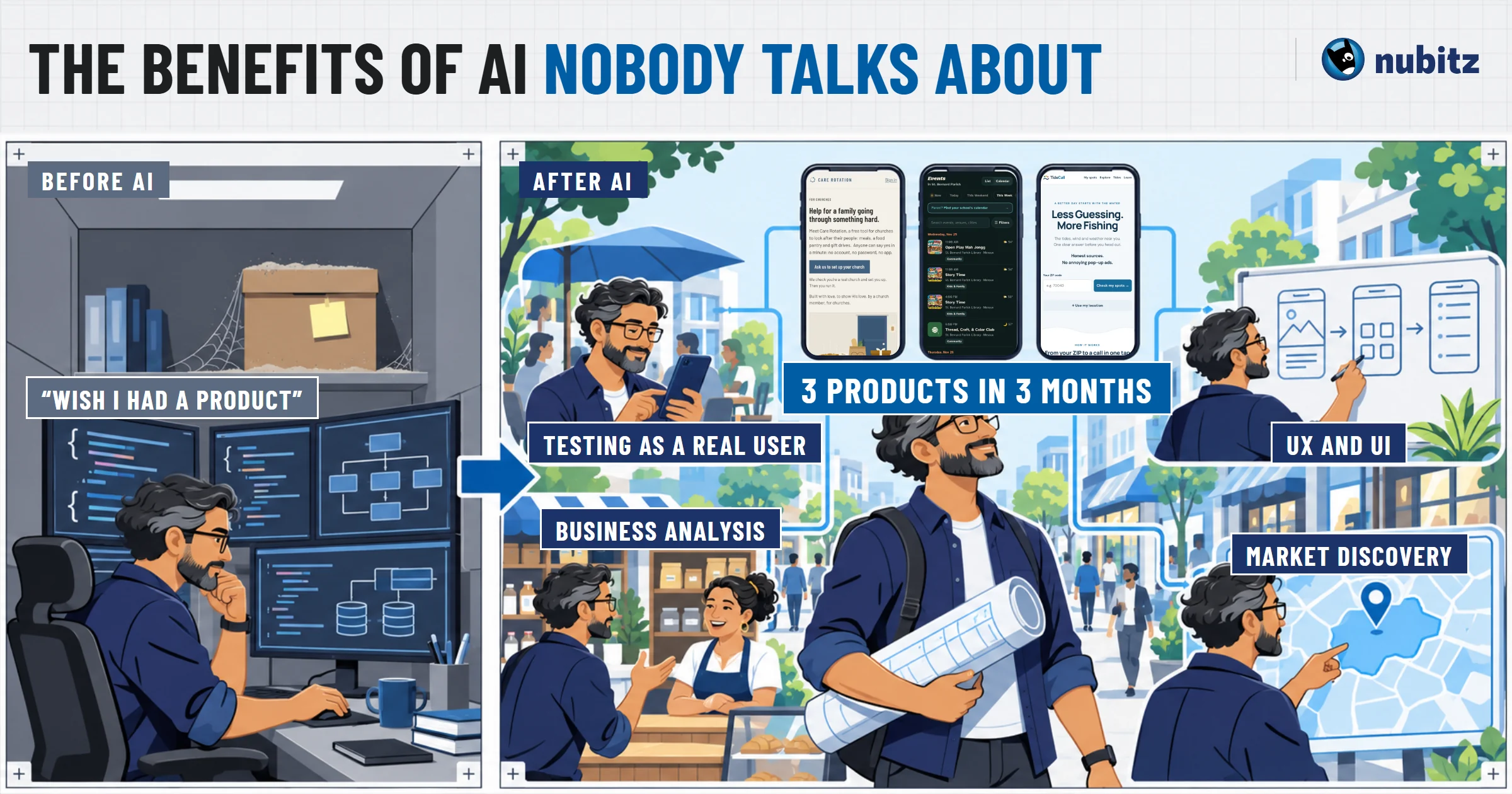
The bigger payoff is what the saved time turns into. I’m substantially better at testing than two years ago, and at UX, UI and other things too. I understand the businesses I build for far better, and I’ve found markets I wasn’t looking for. None of that is because AI does those things better than I do. Not even close. It’s because for the first time I have the hours to do them myself.
Testing, UX, business analysis and market research are real disciplines, and the people who do them well are worth every dollar. On large enough projects, I still bring them in. But AI gives me the time and tools to take on some clients by myself and do much more of that work. It’s made me far more cross-functional and valuable than I’ve ever been.
Twenty years of “we should build a product”
As a developer, then a dev manager, then running my own consultancy, I said the same thing every year: we should build our own product. It never happened.
Two things killed it every time.
Client work came first, because it pays the bills. And there was the fear of spending way too much on something the market might not want.
A real product meant hiring a team for months: developers, a designer, a tester, someone on the business side. If you guessed wrong, you found out after the money was gone.
AI took care of both. A first version now takes days, not months, so client work doesn’t have to stop for it. And if the market doesn’t want it, I’ve lost a few days, not a few months and a budget. The cost of being wrong has never been cheaper, which means there’s no good excuse left not to try.
So I tried. In three months, we shipped three products of our own: Care Rotation, Da Parish Events and TideCall. Each went from start to live in 9, 4 and 3 days.
More time to live in it
On every project, ours or a client’s, we test thoroughly and use what we build. What there was never enough of was time to live in it. Now there is. I use our own products every day, and on client work I spend far more time in the software the way their people will.
On Care Rotation, a volunteer project has a date. The obvious design marks it done when the date passes. That’s not what happens in a church. Crews get rained out. Jobs slide. So a project is done when somebody says it’s done, never because the calendar moved, and the coordinator sees the ones that are past their date and still open. Nobody would have put that in a spec. You only know it if you’ve run the projects.
I wrote earlier about why AI still needs human UX judgment. AI didn’t give me better judgment. It gave me the time to go get more of it.
More time to understand the business
The same saved time goes into conversations. On client work, I spend far more time with the owners and with the people who do the work every day, the ones who know where the process actually breaks.
On our own products, it goes into seeing what others are doing: what similar apps get right, what they miss, and where nobody is serving people at all. It also goes into talking to the businesses around us. Da Parish Events is a community app I built for St. Bernard Parish, Louisiana, and when I walked into Cheesecake Heidi to ask her to sponsor its next giveaway, that was a conversation I wouldn’t have had time for two years ago. She said yes, and we recommend her to anyone who lives here or visits.
Finding TideCall
TideCall is the best example, because I didn’t set out to build it.
In October I added a fishing section to Da Parish Events. In early November, writing the newsletter, I wanted to tell people whether the weekend was a good time to fish, so I asked what the tides were doing. A week later I was thinking about what people would type into Google to find it: fishing tides Shell Beach, fishing tides Delacroix. Not as a fisherman. As someone building a product, with the time to think about it, because I wasn’t burned out writing the same forms and database code for the hundredth time.
Then one afternoon, using my own product again, it hit me that this could scale far past one parish. A straight answer to “should I go out today?” for every US coast. We started building it on November 14, and it went live three days later. More than 7,000 pages later, it’s hard to argue with.
I didn’t find that market by planning it. I found it by running a product and paying attention. Before AI, I’d never have had a product running to pay attention to.
The honest limit
Building is cheap now. Getting people to use it isn’t. You still have to market it and spend a little money to find out whether anyone wants it. And I’m still learning the product game. Shipping three products doesn’t make me an expert at growth.
And shipping software is a lot easier than owning and running it.
If you lead a development team
Your team is getting time back from AI. The easy move is to fill it with more tickets: same work, same blind spots.
The better move is to let them do what I got to do: use what they build, sit with the people who use it, test like a user, own a small product end to end. That’s how developers become the engineers who can see a problem before anyone writes it down.
I haven’t seen many teams do this yet, but it’s a real step toward real innovation.
The real benefit
AI made me faster. That part is real. You can see it in what we’ve built. And speed was the problem. There was never enough time for the people building the software to truly own it: to be its users, to understand the business well enough to think a step ahead of it, to innovate instead of sitting through another retrospective about why the same bugs came back.
AI gave me that time. What I did with it is the part nobody talks about.